
What do bee-flies look like
There are two species of bee-fly that you can see in spring (from late February to June). Their names provide good clues to tell them apart: Dark-edged Bee-fly has a dark band on the front edge of its wings, and Dotted Bee-fly has dark dots on its wings. There are also some differences in the colour of the hairs on the body, especially on the 'tail' (tip of the abdomen).
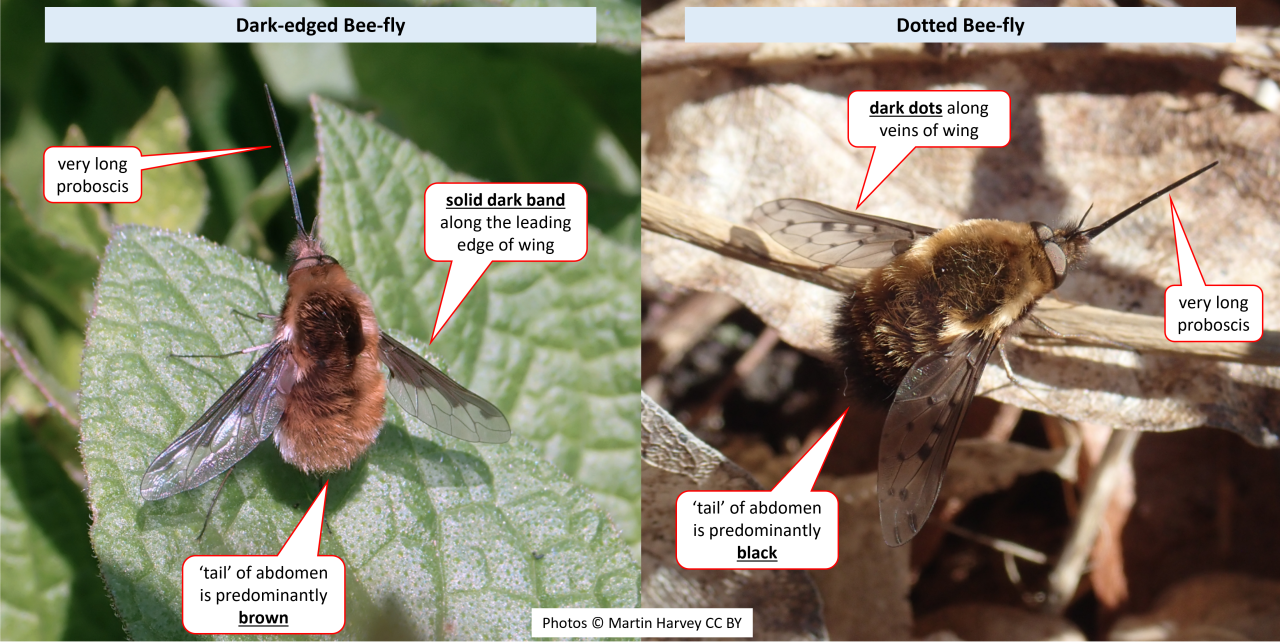
Further guidance is available to download in our bee-fly identification guide (pdf). You may also be able to get help with identifications via the recording scheme on Bluesky or on our Soldierflies Facebook group, or via the forum pages on this website (DF members only). The tag for all our social media is #BeeFlyWatch.
How do bee-flies behave
Bee-flies can sometimes be seen sitting on bare ground, leaves, walls or fences in the sunshine, basking to warm themselves up. They like to visit flowers and have amazing hovering skills as they dart from one flower to another. If you are lucky you may also be able to observe female bee-flies picking up sand grains from patches of bare soil, where they can be seen 'twerking' their backsides to collect sand into a special pouch at the tip of their abdomen. When laying their eggs they use the sand to coat the eggs and provide them with some protection against drying out.
Where can you find them
Dark-edged Bee-fly is found throughout England and Wales, and is also widespread in coastal and lowland areas of Scotland (but is not known from Orkney or Shetland). There are no recent records from Ireland. You can see them in gardens, grasslands, and woodland paths and clearings.
Dotted Bee-fly is mainly a species of southern England, but it also occurs in parts of south and east Wales, and has been extending its range in recent years. It can be found in similar places to Dark-edged Bee-fly, with a particular liking for grasslands, gardens and brownfield sites.
Beware of look-alikes!
There are are some other insects that fly in spring and look a bit similar to bee-flies, and every year we get a few reports of these 'bee-fly pretenders'.
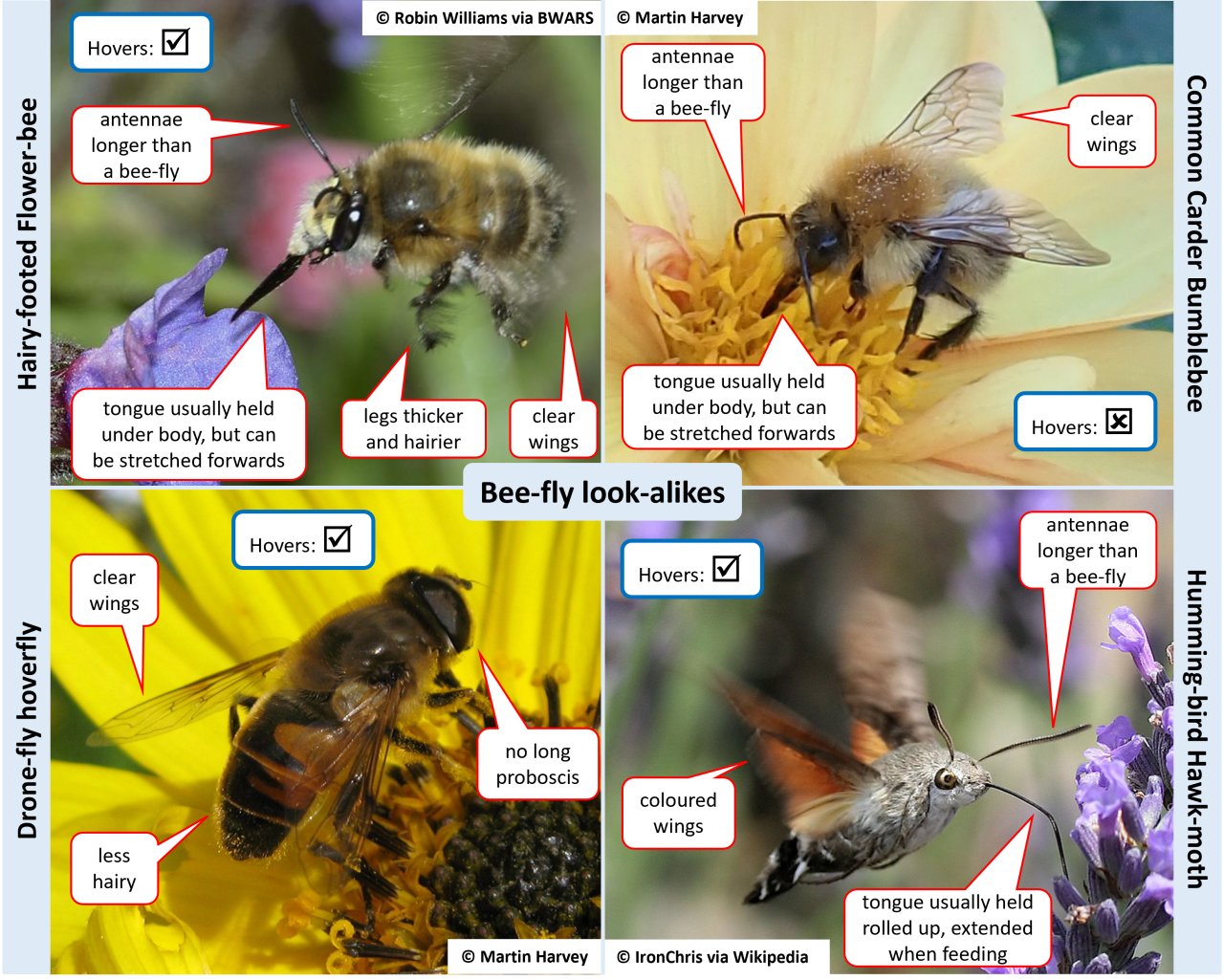
Hairy-footed Flower-bee: flies at the same time and in the same places as bee-flies, is also very good at hovering, and can extend its tongue so that it looks like the long proboscis of the bee-fly. Male Hairy-footed Flower-bees are similar in colour to bee-flies as well (female Hairy-footed Flower-bees are almost entirely black). Bees have longer antennae than bee-flies, and there are no dark bands or spots on their wings. Hairy-footed Flower-bee also has thicker, hairier legs than a bee-fly.
Common Carder Bumblebee: another bee that can be seen alongside bee-flies. Carder Bumblebees do not hover as well as bee-flies do, and again the bumblebees have clear wings and longer antennae.
Drone-fly hoverfly: these hoverflies can be seen all year, and they like to hover over flowers in a similar way to bee-flies. However, drone-flies have clear wings, they do not have a long proboscis, and their body is not as hairy and fluffy as a bee-fly.
Humming-bird Hawk-moth: a beautiful moth that hovers over flowers, sometimes extending its tongue (proboscis) into the flower. This behaviour means that it can be confused with bee-flies. However, the Humming-bird Hawk-moth has its wings completely covered with scales (grey forewings and orange hindwings), and has long antennae.