General discussion

Description

General news and comments about true flies (Diptera) and the Dipterists Forum

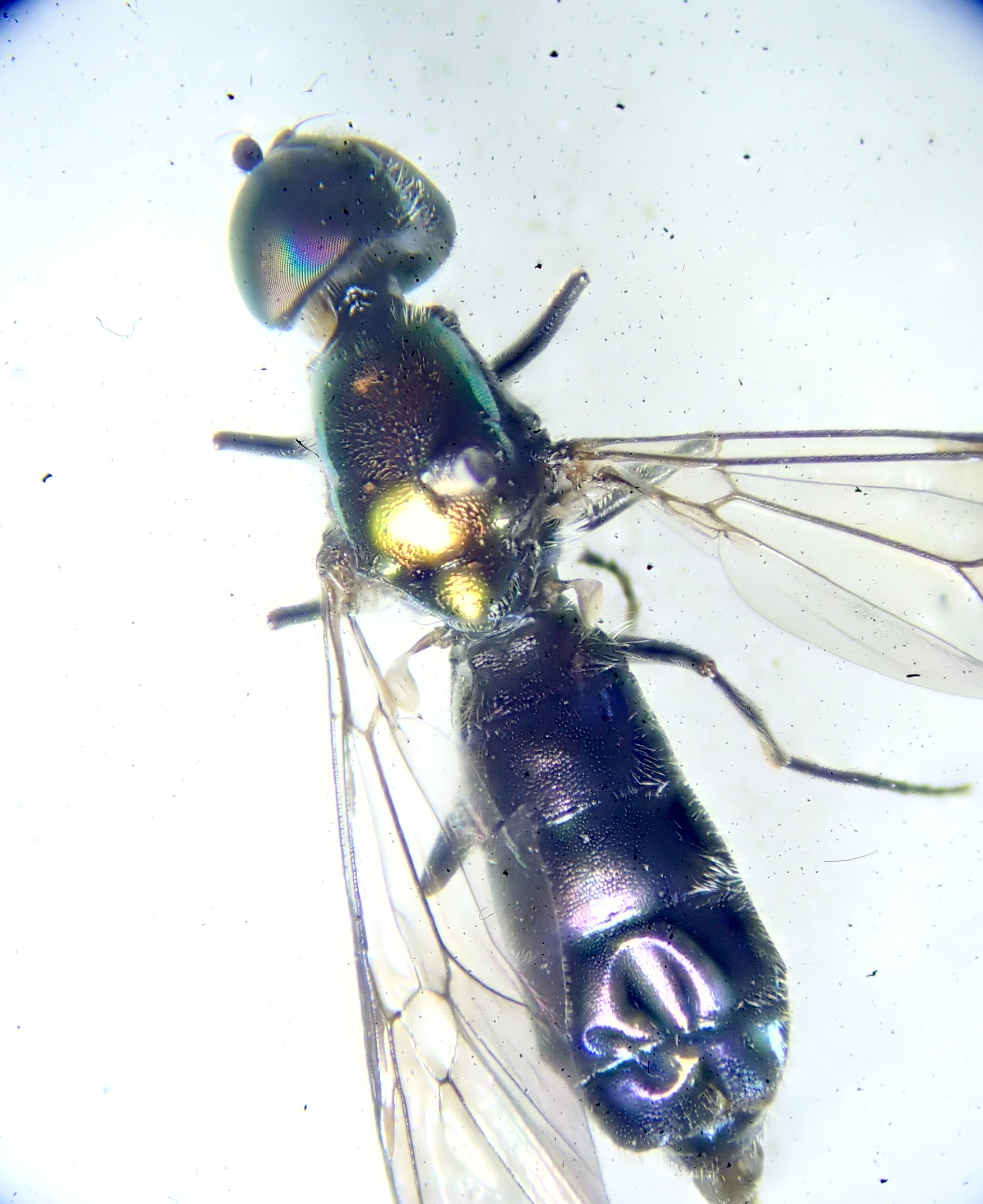
Brachypalpus laphriformis Diptera Syrphidae

Submitted by BoydBarr on

I am looking for records for B. laphriformis from Scotland.

I have recently recorded this species for the first time in Ballinluig Nr. Pitlochry, Perthshire.

3 specimens so far, first, in malaise trap 13-27 May 2022, second, 7th June 2022,  third, 1st July 2022.

I can see no other records for Scotland within the Literature, however, I have found two other records in Gbif data. The first from NN9848 3622 on 23rd May 2018 recorded by Carl C. Farmer, the second From NN1283 8763 recorded by Ian I. Strachan.
DF Bursaries for events in 2023

Each year Dipterists Forum offers bursaries towards the costs of attending our spring identification workshop at FSC Preston Montford, and our summer field meeting. The bursaries cover half of the total costs (including accommodation).

Is this a Ferdinandea cuprea female?

Found on 8th August in my Leicestershire garden.


Approx. 10mm long.  Various characteristics seem to fit with F. cuprea rather than F. ruficornis, but I'm not sure whether there have been any recent 'confusion species' arrivals from Europe. I would be grateful for comments.


Scathophaga calida - could there be two British species under this name?

Submitted by SFalk on

Had lots of encounters with Scathophaga calida in the Hebrides this summer where it sometimes outnumbers S. litorea. Was just adding some additonal photos to my Flickr site last night (and comparing the material I had to hand) which allowed me to critically compare my Hebridean material (that is the clearly the same as Skye material from Jon Cole at OUM) with some Shetland material sent to me by Roger Thomason a few years ago (also featured in the Diptera.info gallery as photos of living flies).

Lonchoptera

I have a male Lonchoptera which keys out in Ken Smith's Handbook to L. furcata.  It's difficult to compare his genitalia figures to my photo, so confirmation would be welcome.  KS says that males are rare, but he was writing in1969 - there may be more evidence around since then.

Sargus cuprarius or S. irridatus

I have a female Sargus which is hard to place as between S. cuprarius and C. irridatus.  The text in the Soldierflies book accepts there will be problems and identification can be confirmed only via the genitalia.  When I examined this female she proved to have a clutch of six eggs in the end of the addomen. Apart from i/d, therefore, I'd welcome guidance on whether by careful conservation I could keep the eggs viable through to the adult stage.

Help with fly ID

Submitted by Ivybee52 on

I am intrigued by the fly attached which has yellow legs. The fly was seen in the last week in central England. 

Help, please.

Thanks.

Lonchopteridae

My question relates to the key in Kenneth Smith's handbook of 1969.  I have a female specimen swept locally two days ago which keys out to L. nigrociliata.  My first assumption (that I had the very common L. lutea) falls at the first fence where the decision is based upon a bristle on the middle tibia - which my specimen has and lutea does not.  The key also points to females of nigrociliata having wing vein a1 ending 'very much beyond' the m fork, as mine does.